
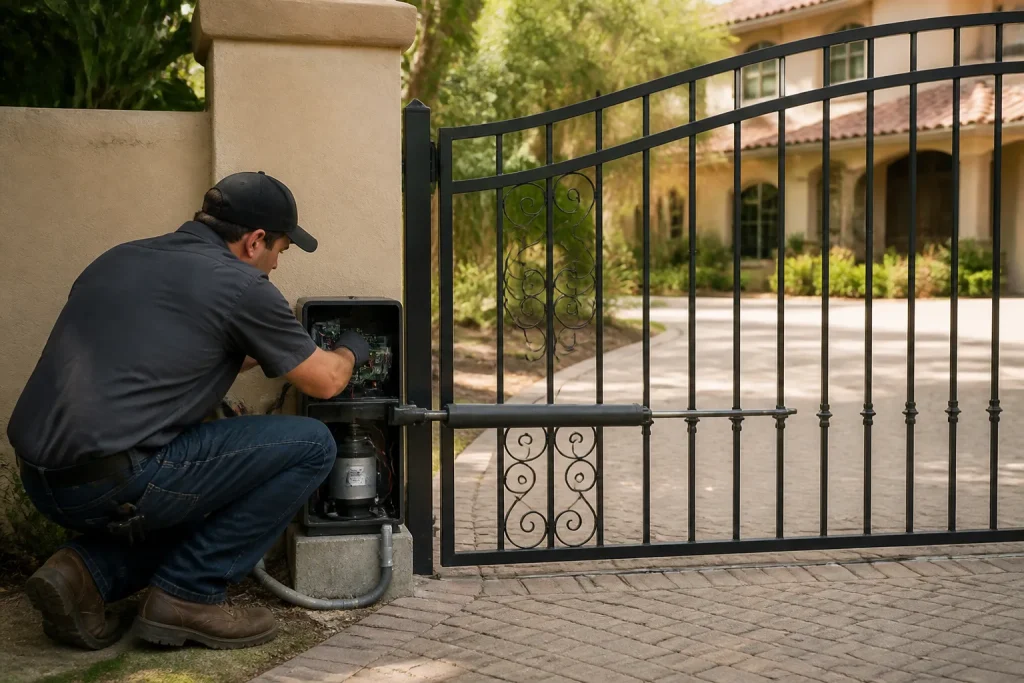
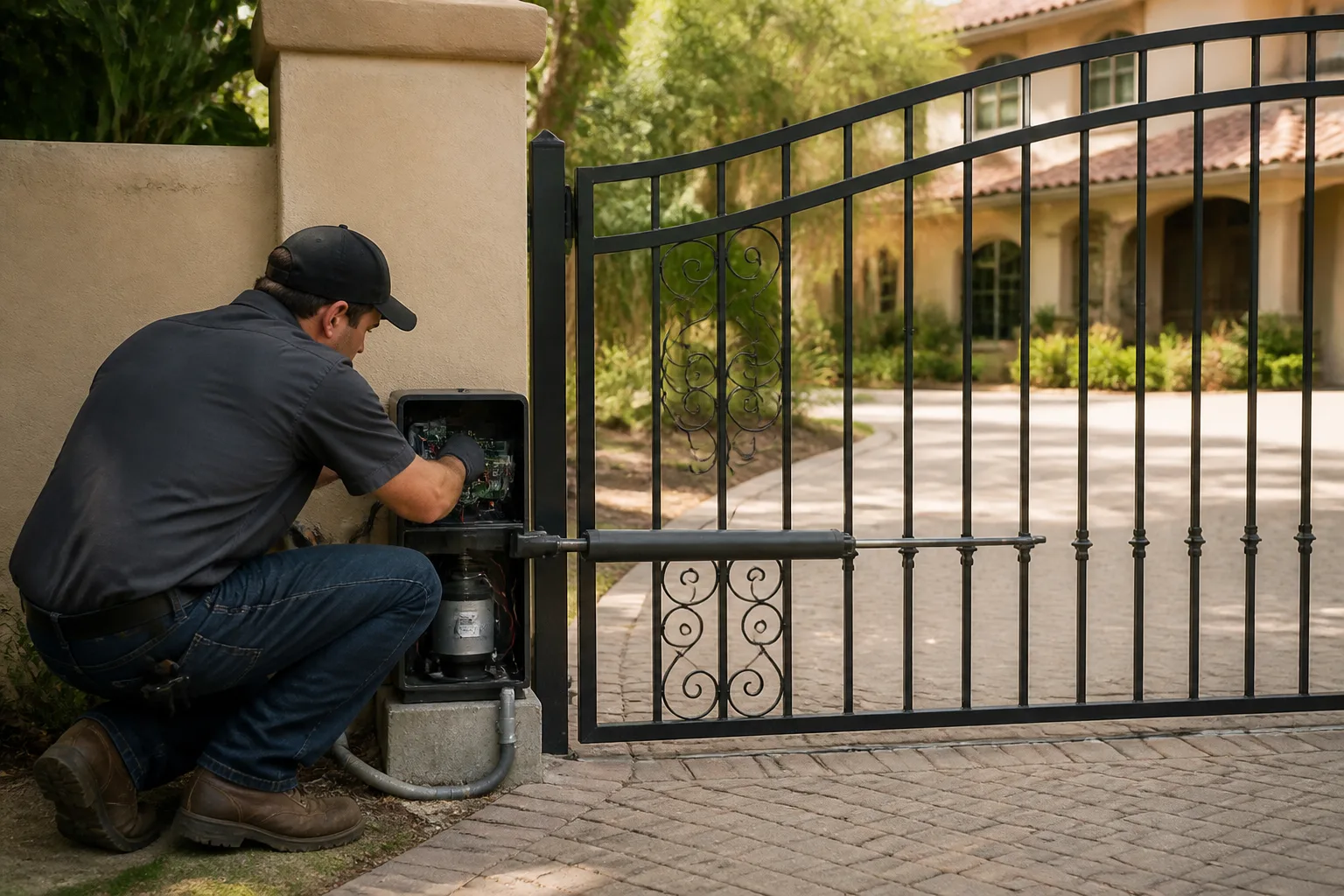
Emergency Gate Repair Near Me: What San Diego Homeowners Should Do First
If your gate just failed, the first thing to do is determine whether it’s a manual or automated system. For automated gates, never force the gate open without releasing the operator first. That single pull can strip the drive gear, bend the arm, and void the operator warranty. Then call a gate specialist, not a generalist. If you’d rather not deal with it yourself, call San Diego Gate Company at (877) 517-5469 and we’ll walk you through it.
The 15-Minute Window That Determines Everything
In the 15 minutes after a gate fails, most San Diego homeowners make one of three mistakes. They force the gate open. They call the first number that pops up, which is often an answering service, not a technician. Or they do nothing and leave a broken gate half-open, which is worse than a closed one because it advertises a point of entry that no longer locks.
What you do in that window determines whether the repair takes one hour or three, and whether you create secondary damage that doubles the bill. Forcing an automated gate manually without disengaging the operator is the most expensive mistake. We’ve seen a single hard pull strip a Viking operator’s drive gear beyond repair. That’s a $400 part replaced for no reason other than impatience.
Think of it like this: the operator is still connected to the gate. Pulling the gate means pulling through the gearbox. That gearbox was never designed to be back-driven. When you force it, you’re using the gate as a lever against your own motor.
How to Release the Four Most Common San Diego Gate Operators
Every automated gate has a manual release. The procedure varies by operator type, and doing it correctly takes about 30 seconds. Doing it wrong is what costs money.
Swing Arm Operators (Linear, Elite, Ghost Controls)
Look at the operator housing mounted on the gate or the post. There’s a release lever, usually a small metal handle or a keyed cylinder. On most Linear and Elite swing arm units, you’ll find a plastic T-handle or a quarter-turn release. Turn it counterclockwise until you feel it disengage. The arm should now swing freely. On Ghost Controls systems, the release is often a small pull-pin at the base of the arm. Pull it out, and the arm separates from the operator.
Once released, you can move the gate by hand. But do it slowly. A released swing gate will catch wind, and wind in San Diego’s coastal neighborhoods like Point Loma or La Jolla can whip a 14-foot gate hard enough to bend its own hinges.
Underground Operators (FAAC, BFT)
Underground operators sit inside a box below the gate hinge. The release is typically a small metal key or hex fitting on the top of the foundation box. Turn it to disengage the motor from the drive shaft. On FAAC and BFT units, you’ll often need a 6mm or 8mm hex key. If you don’t have one, don’t improvise with pliers. A stripped release fitting turns a $95 service call into a $350 extraction job.
Sliding Gate Operators (DoorKing, Viking, Mighty Mule)
Slide gate operators sit inside a metal box next to the gate track. Open the box. You’ll see a release lever or a pull-chain depending on the model. DoorKing units typically have a red T-handle that you pull up and rotate. Viking models often use a spring-loaded lever that you push down. Once released, the gate will slide manually along its track. If it doesn’t move, check for a physical obstruction before forcing anything.
Overhead Operators (LiftMaster, Elite)
These are rarer in San Diego but we service them in older residential developments in Clairemont and Mira Mesa. The release is almost always a red cord hanging from the operator rail. Pull straight down and back toward the operator. The gate disengages with a click. These are the simplest to release and also the easiest to re-engage incorrectly, so take a photo of the release position before you touch it.
If any of this feels unclear, call (877) 517-5469 and describe what you’re looking at. We’ll identify your operator from your description and walk you through the release in under two minutes.
Securing the Gate Opening While You Wait
Once the gate is released and moved to your preferred position, you need to keep it there. A swinging gate left unsecured becomes a wind-driven hazard. A sliding gate left partially open is an invitation.
For swing gates, ratchet straps work. Hook one end to the gate’s vertical frame, the other to a post or a vehicle parked within reach. If you don’t have straps, a sturdy rope through the gate’s pickets tied to something solid will hold it. In a pinch, we’ve told customers to block the gate with a wheeled trash bin weighted with sand or water. Not elegant, but it works for overnight security in neighborhoods like North Park where pedestrian traffic is constant.
For sliding gates, use a c-clamp if you have one. Clamp it onto the track directly behind the gate wheel. No c-clamp? A length of chain threaded through the gate frame and padlocked to the track keeps the gate from moving. Whatever you use, the goal is preventing the gate from moving on its own, not creating a permanent fix.
One note for HOA managers and commercial property operators: if the gate secures a pool area or a parking structure, you may have a legal duty to keep it locked or barricaded until repaired. San Diego code enforcement takes pool gate failures seriously. A temporary chain and padlock satisfies most inspectors.
What to Gather Before You Call
The more information you give the technician before they dispatch, the faster the repair. Here’s what saves diagnostic time on arrival:
- Operator brand and model. Look for a sticker on the operator housing or inside the control box. Common brands in San Diego include San Diego Gate Company favorites like DoorKing, Viking, and Ghost Controls. If the sticker is faded, a photo of the unit helps.
- What the gate was doing before it failed. Was it opening slower than usual? Making a grinding noise? Stopping halfway and reversing? These symptoms narrow the diagnosis before the truck even leaves.
- Recent changes or events. Did it rain? A power outage? Landscaping work near the gate? New remotes or keypads added? Underground wire damage from irrigation work accounts for a surprising number of San Diego service calls.
- How the gate behaves now. Does it hum when you press the button? Is the keypad beeping but nothing moves? Is the gate physically stuck or just unresponsive? These details tell us whether it’s electrical, mechanical, or control-board related.
And here’s a tip that most people don’t think about: check the circuit breaker before you call. Automated gates run on their own breaker, and after a power surge or a storm, that breaker trips. If the breaker is fine but the gate still won’t move, try the release procedure above and test the gate by hand. If it moves freely by hand, the mechanical side is fine and the problem is electrical. That single test cuts diagnostic time in half.
How to Tell If a “24/7 Emergency Service” Company Actually Means It
Every gate company in San Diego advertises 24/7 emergency service. Very few actually have a technician on call at 2 a.m. Most forward to an answering service that takes a message and calls a technician in the morning. That’s not 24/7 service. That’s a voicemail with extra steps.
When you call, ask these three questions:
- “Will I speak to a technician or an answering service right now?” If they say answering service, you’re not getting emergency service. You’re getting a message taken.
- “What’s the actual dispatch time for someone to be on site?” A real emergency service gives you a window. If they can’t or won’t, be suspicious.
- “Is there an emergency service fee, and does it include the first hour of labor or is it on top of it?” A legitimate company tells you the fee structure upfront. A company that dodges this question will likely pad the invoice later.
We do genuine emergency response for Gate Repair in San Diego because gates aren’t a side service for us. When you call our emergency line, you’re reaching a gate technician, not a call center. That’s the difference between a specialist shop and a company that runs gate repair ads alongside HVAC and pressure washing.
Which Failures Actually Require a Midnight Call
Not every gate failure is an emergency. We tell our San Diego customers this because honest advice saves them money. Emergency rates exist because technicians drop everything and drive across the county at midnight. If the problem can safely wait until morning, don’t pay the emergency premium.
Call immediately if:
- The gate is stuck open or half-open, especially if it secures a pool, a commercial lot, or a home where the gate is the primary perimeter security.
- The operator is making a grinding, screeching, or rapid clicking noise. That’s usually a gear or chain actively destroying itself. Shut off the breaker and call.
- The gate closed on a vehicle or person and won’t reverse. This is a safety sensor failure and needs immediate attention, especially in family neighborhoods like Scripps Ranch or Rancho Bernardo.
- You run an HOA or commercial property where the gate is required for access control and it’s blocking residents or tenants.
Can wait until morning if:
- The gate is fully closed and locked in position, even if the operator is dead. A closed gate is still a barrier.
- You can manually release the gate and secure it closed with straps or a chain.
- The remote or keypad stopped working but the gate itself is fine and secure.
- The gate opens fine but won’t close automatically. You can close it manually and secure it for the night.
If you’re unsure, call and describe the situation. We’ll tell you honestly whether it’s a true emergency or something that can wait until 7 a.m. That’s part of being a gate specialist, not a generalist. We diagnose the real problem without upselling you a new system when a repair will do.
Why the Repair Takes One Hour or Three
The difference between a one-hour repair and a three-hour repair usually comes down to what happened in the first 15 minutes after the failure. Here’s what we mean.
Last month we got a call from a homeowner in Carlsbad. Their Gate operator had stopped responding. Before calling us, the homeowner’s neighbor, a well-meaning guy who’s good with cars, tried to help by forcing the gate open manually. He didn’t release the operator first. By the time we arrived, the gate leaf was bent at the hinge, the drive gear on the Ghost Controls operator was stripped, and the arm mounting bracket had sheared off a post bolt. What would have been a $180 circuit board swap became a $900 mechanical job.
We’ve also seen the opposite. A customer in Mission Valley called us after their Viking slide gate stopped working. They didn’t touch it. They secured it closed with a bike lock through the frame and the track, took photos of the operator, and called us. Our technician arrived with the right part, replaced a $40 capacitor, and was gone in 55 minutes.
The lesson isn’t “don’t touch anything.” It’s “know what to touch and what to leave alone.” That’s the information gap this post exists to close.
When the repair involves Electric Gate Repair in San Diego, the diagnostic process is methodical. We check power first, then the control board, then limit switches, then the motor itself. Most failures are electrical, not mechanical. But a homeowner who has been forcing the gate manually turns an electrical problem into an electrical and mechanical problem. That’s when repairs get expensive.
When to Call a Pro
If any part of the release procedure feels unclear, stop and call. The cost of a service call is less than the cost of a stripped gear, a bent gate leaf, or a voided warranty. If the operator is making noise, shut off the breaker and call. If the gate is stuck in a position that compromises your security, call. That’s the short version.
And here’s the honest truth from someone who does this every day: most gate failures in San Diego are repairable. The gate doesn’t need to be replaced. The operator doesn’t need to be upgraded. A $30 limit switch or a $75 control board capacitor fixes most problems. But only if the gate hasn’t been forced open and damaged in the meantime.
If you need help, we work on virtually every major gate brand, including yours. Whether it’s a Viking slide gate in Chula Vista, a DoorKing swing gate in Poway, or a Ghost Controls system in Encinitas, our technicians have the training and the parts to get it working again. Related services: Gate Installation in San Diego for when repair isn’t enough and a new system makes more sense.
The Bottom Line
Here’s what to remember when your gate fails in San Diego:
- Never force an automated gate open without releasing the operator first. That single mistake causes more secondary damage than any other.
- Learn your gate’s manual release procedure before you need it. Take a photo of the release mechanism now, while the gate still works.
- Secure the gate opening temporarily with straps, chains, or clamps. A half-open gate is a security liability.
- Gather the operator brand, symptoms, and recent events before calling. It saves diagnostic time and money.
- Ask any “24/7” company if you’re talking to a technician or an answering service. If it’s not a technician, it’s not emergency service.
- Know which failures are true emergencies and which can wait until morning. Don’t pay midnight rates for a problem that’s safe to leave until dawn.
If you’re in San Diego and need help with a gate that won’t cooperate, San Diego Gate Company offers free estimates. Call (877) 517-5469 and you’ll speak with a gate technician, not a call center. From a broken hinge to a full electric gate installation, one call covers it.
Frequently Asked Questions
Emergency gate repair in San Diego typically runs $180 to $450 for a standard service call after hours, with parts additional. The final price depends on the operator brand, the specific failure, and whether manual forcing caused secondary damage. Most emergency repairs we handle fall in the $200 to $600 range total. Call (877) 517-5469 for an exact quote based on your gate and operator. Estimates are free.
Yes. San Diego Gate Company offers same-day service and genuine 24/7 emergency response with technicians who are actually on call, not an answering service forwarding messages. If you call about a stuck open gate or a gate that won’t secure, we’ll dispatch a technician. Call (877) 517-5469 and describe the problem to get a realistic arrival window.
Yes, and often severely. Forcing an automated gate without disengaging the operator back-drives the gearbox, which it was never designed to handle. This can strip drive gears, bend arms, and void warranties on brands like DoorKing, Viking, and Ghost Controls. Use the manual release procedure instead, or call us and we’ll walk you through it.
We’re brand-agnostic. Our technicians are trained on nine major gate and access-control brands, including Viking, Ghost Controls, DoorKing, and Elite, as well as LiftMaster, FAAC, BFT, Linear, and Mighty Mule. We diagnose the real problem on the system you already own. We don’t push unnecessary replacements or force you into a brand switch.
Written by the team at San Diego Gate Company, serving San Diego since 2018.
Need Gate Repair Help?
Call San Diego Gate Company — licensed & insured, here with fast after-hours help in San Diego.
(877) 517-5469